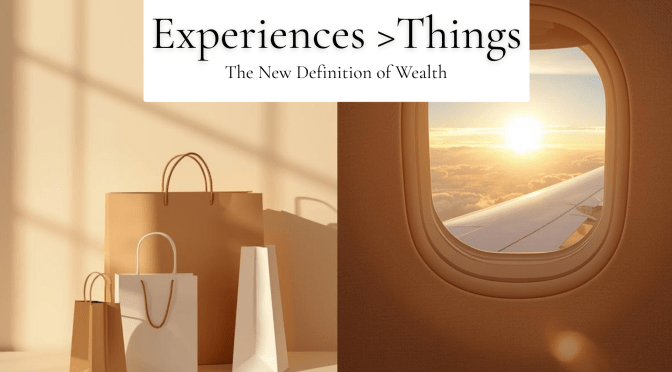
For decades, success was measured by accumulation.
A bigger house.
A fuller closet.
A garage that proved progress.
But something shifted.
In 2026, the most fulfilled global citizens are not asking, “What do I own?”
They’re asking, “What have I experienced?”
High-value minimalism is not about rejecting wealth.
It’s about redirecting it.
It’s the philosophy of investing in experiences over belongings. This means choosing global living, cultural immersion, and personal growth over material accumulation. And it may be one of the smartest lifestyle strategies of our time.
What Is High-Value Minimalism?
Traditional minimalism focuses on owning less.
High-value minimalism focuses on owning intentionally and investing in depth.
It’s not aesthetic decluttering.
It’s strategic life design.
Instead of spending on fast fashion, impulse tech upgrades, or decorative status symbols, high-value minimalists invest in:
- Travel experiences
- Cultural immersion
- Education and skill-building
- Wellness retreats
- Language learning
- Global networking
- Memory-creating adventures
It’s not anti-money.
It’s pro-meaning.
The Data Behind Experiences vs. Things
Research in behavioral psychology consistently shows that experiential purchases create more lasting happiness than material purchases.
A widely cited study by Dr. Thomas Gilovich at Cornell University found that people derive more enduring satisfaction from experiences than from possessions. Material goods tend to depreciate emotionally as we adapt to them. Experiences, however, integrate into our identity and memory.
Why?
Because experiences:
- Strengthen social bonds
- Become part of your personal narrative
- Increase gratitude over time
- Are less likely to trigger comparison
Belongings fade into the background.
Experiences become who you are.
The Global Living Philosophy
High-value minimalism aligns closely with the global living mindset.
Global living isn’t necessarily about being a full-time digital nomad. It’s about expanding perspective intentionally.
It means:
- Spending money on international exposure
- Exploring different cultures and economies
- Learning how other societies approach life, work, and happiness
- Building a diversified identity, not just a diversified portfolio
When you invest in experiences, you invest in cognitive flexibility.
Exposure to different cultures improves problem-solving skills and adaptability. Studies in social psychology suggest that multicultural experiences enhance creativity and open-mindedness — both valuable assets in entrepreneurship and investing.
Perspective compounds.
Why Belongings Rarely Deliver Long-Term Fulfillment
Material possessions have three psychological limitations:
1. Hedonic Adaptation
The excitement fades. Quickly.
That luxury bag, new car, or upgraded phone becomes normal within weeks. The dopamine spike disappears.
2. Social Comparison
Possessions often invite comparison. There will always be someone with more.
Experiences, on the other hand, are uniquely yours.
3. Depreciation
Most belongings lose financial value. Experiences often increase emotional value over time.
Think about it:
A sunset in Santorini may cost less than a designer accessory. Yet its memory grows more valuable every year.
The Economics of Experiential Investing
This philosophy isn’t reckless spending. It’s intentional allocation.
High-value minimalism asks:
- Does this purchase expand my perspective?
- Will this deepen my relationships?
- Will this memory compound in meaning?
- Does this align with the life I want to design?
Instead of default consumption, you build a values-based spending strategy.
Examples:
- Redirecting shopping budgets toward a cultural trip
- Choosing a language course over another gadget
- Booking a retreat that enhances mental clarity
- Investing in local experiences when traveling, not just luxury stays
It’s conscious spending — not impulsive accumulation.
Identity Equity: The Hidden Return on Experiences
There is a concept rarely discussed in finance: identity equity.
Every meaningful experience contributes to who you become.
Traveling solo builds confidence.
Living abroad builds resilience.
Navigating foreign systems builds independence.
Exposure to different economic systems builds financial perspective.
These are intangible assets.
You cannot store them in a closet.
But they compound for life.
Identity equity influences:
- Career opportunities
- Decision-making quality
- Risk tolerance
- Emotional intelligence
- Global awareness
In a world that rewards adaptability, experiential wealth may outperform material wealth in long-term impact.
High-Value Minimalism and Financial Freedom
Some assume prioritizing experiences means neglecting financial discipline.
In reality, it often requires greater discipline.
High-value minimalists typically:
- Avoid lifestyle inflation
- Resist trend-driven spending
- Invest strategically
- Save intentionally for experiences
- Focus on long-term wealth building
They understand that freedom requires financial stability.
The difference is allocation.
Instead of spending excess income on accumulating more, they fund:
- Travel portfolios
- Learning opportunities
- Global mobility
Money becomes a tool for expansion — not storage.
Practical Steps to Shift from Possessions to Experiences
Here’s how to apply this philosophy immediately:
1. Conduct a Lifestyle Audit
Review the last six months of spending.
How much went toward belongings versus experiences?
Awareness is the first shift.
2. Create an “Experience Fund”
Just like an emergency fund — but for growth.
Allocate a percentage of income toward:
- Travel
- Courses
- Cultural events
- Retreats
- Skill development
Intentional funding reduces guilt and increases impact.
3. Apply the 30-Day Rule
Before purchasing a non-essential item, wait 30 days.
Ask:
Would I rather own this — or remember something unforgettable?
4. Invest Locally, Not Just Globally
Experiential wealth doesn’t require international flights.
It can include:
- Exploring nearby cities
- Attending workshops
- Trying new cuisines
- Cultural festivals
- Outdoor adventures
Expansion is about exposure — not distance.
5. Design a Global Life Vision
Where do you want perspective from?
Asia’s efficiency?
Europe’s lifestyle balance?
Scandinavia’s design minimalism?
Latin America’s community culture?
Experiences become strategic when they align with vision.
The Quiet Luxury of Global Living
True luxury isn’t excess.
It’s access.
Access to:
- Freedom of movement
- Cross-cultural understanding
- Time flexibility
- Memory creation
- Intellectual expansion
High-value minimalism feels calm.
It’s not loud wealth.
It’s layered depth.
You don’t need to prove status when your life is rich in experience.
Mind + Adventure: The Compounding Effect
When you invest in experiences, you invest in:
- Emotional intelligence
- Broader financial awareness
- Cultural literacy
- Adaptive thinking
- Confidence
These traits influence your earning power, leadership, and investing mindset.
Belongings occupy space.
Experiences create depth.
And depth is what builds a meaningful life.
Final Thought: Wealth Is Not What You Store — It’s What You Become
High-value minimalism isn’t anti-success.
It redefines success.
It asks you to build a life that feels expansive — not cluttered.
In 2026 and beyond, the most powerful investors won’t just diversify assets.
They’ll diversify perspective.
Because in the end:
Closets can be emptied.
Memories cannot.
Invest in moments.
Build identity equity.
Live globally.
That is wealth.
 Mind, Money & Adventures