
Bond ratings are a cornerstone of fixed-income investing. They provide a snapshot of an issuer’s creditworthiness, helping investors assess the risk of default and make informed decisions. Whether you’re a beginner or a seasoned investor, understanding bond ratings is essential for building a secure and profitable portfolio.
In this section, I’ll break down bond rating scales. I will explain their definitions. You will learn how to use them effectively in 2025.
What Are Bond Ratings?
Bond ratings are letter grades assigned by credit rating agencies to evaluate the financial strength of bond issuers. These ratings range from high-grade (low risk) to low-grade (high risk). The higher the rating, the lower the risk of default—but also the lower the yield. Conversely, lower-rated bonds offer higher yields but come with increased risk.
Who Assigns Bond Ratings?
Three major credit rating agencies dominate the bond market:
- Moody’s Investors Service
- Standard & Poor’s (S&P)
- Fitch Ratings
Each agency uses a slightly different scale, but their ratings are broadly similar.
Bond Rating Scales and Definitions
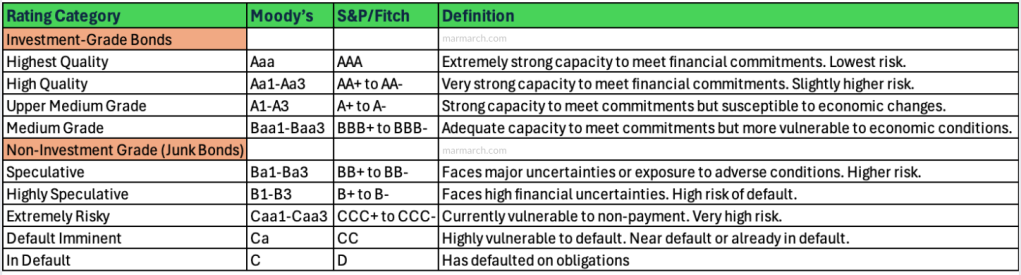
Why Bond Ratings Matter
- Risk Assessment: Ratings help you gauge the likelihood of an issuer defaulting on its debt.
- Yield Determination: Lower-rated bonds (e.g., junk bonds) offer higher yields to compensate for increased risk.
- Portfolio Allocation: Ratings guide you in building a balanced portfolio that aligns with your risk tolerance.
- Market Confidence: High ratings boost investor confidence, making it easier for issuers to raise capital.
How to Use Bond Ratings in 2025
- Focus on Investment-Grade Bonds: If safety is your priority, stick to bonds rated BBB- or higher.
- Diversify with High-Yield Bonds: For higher returns, consider adding a small portion of BB or B-rated bonds to your portfolio.
- Monitor Rating Changes: Credit ratings can be upgraded or downgraded based on the issuer’s financial health. Stay updated to avoid surprises.
- Combine Ratings with Other Metrics: Use ratings alongside yield, duration, and issuer fundamentals to make well-rounded decisions.
Key Trends in Bond Ratings for 2025
- Rising Default Risks: With economic uncertainty, some corporate bonds may face downgrades. Focus on issuers with strong balance sheets.
- Green Bond Ratings: As ESG (Environmental, Social, and Governance) investing grows, agencies are developing frameworks to rate green bonds.
- Sovereign Debt Concerns: Keep an eye on government bonds from countries with high debt levels, as they may face downgrades.
Final Thoughts
Bond ratings are an essential tool for evaluating risk and making informed investment decisions. By understanding the rating scales and their implications, you can choose bonds that align with your financial goals and risk tolerance. Happy Investing!
- Identifying Good vs. Bad Influence: A Psychological Approach
- Millennials & Gen X: Breaking the Paycheck-to-Paycheck Cycle
- Castles, Coastlines & Cobblestones: Our Epic 11-Day UK Itinerary Through England & Scotland 🇬🇧
- How to Rewire Your Brain for Success: A Neuroscientific Guide to Unlocking Your Potential
- Unlocking the Power of Mutual Funds: Your Gateway to Smart Investing
 Mind, Money & Adventures