Most people think financial safety means doing the responsible thing.
Save money.
Avoid risk.
Keep cash in the bank.
Stay comfortable.
At first glance, that sounds smart.
And sometimes, it is.
Having emergency savings, avoiding reckless debt, and maintaining financial discipline are all important.
But there’s a hidden danger that many people never talk about.
Sometimes what feels safe financially…
is quietly costing you wealth.
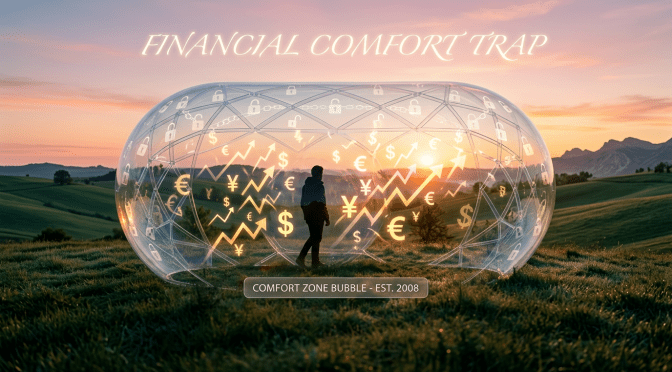
This is the financial comfort trap.
It happens when people become so focused on avoiding risk that they unintentionally avoid growth.
They prioritize comfort over opportunity.
Security over strategy.
Safety over long-term wealth building.
And over time, that decision can become very expensive.
Not because they’re making bad choices.
But because they’re making overly comfortable ones.
In 2026, understanding this trap may be one of the most important financial mindset shifts you can make.
What Is the Financial Comfort Trap?
The financial comfort trap happens when you become attached to decisions that feel emotionally safe—but financially limiting.
Examples:
- keeping too much money in cash
- avoiding investing due to fear
- delaying opportunities because of uncertainty
- staying in financial habits that feel familiar
The problem?
Comfort creates the illusion of safety.
But safe and comfortable are not always the same.
Sometimes comfort simply means:
- predictable
- familiar
- emotionally easier
That doesn’t always mean financially optimal.
And this is where many people get stuck.
They aren’t moving backward.
But they also aren’t moving forward.
They stay financially stagnant.
Why Our Brain Loves Financial Comfort
This isn’t just about money.
It’s psychology.
Human beings are wired to avoid uncertainty.
Your brain prefers what feels familiar because familiarity feels safe.
This explains why many people:
- hesitate to invest
- fear market volatility
- avoid calculated risks
- hold excessive cash
Even when they understand investing logically…
emotionally, uncertainty feels uncomfortable.
And discomfort often feels dangerous.
But wealth building requires something uncomfortable:
Uncertainty.
There is no wealth-building path with zero uncertainty.
Every financial decision carries trade-offs.
The question isn’t:
Can I avoid risk completely?
The better question is:
Which risks are worth taking?
That shift changes everything.
The Hidden Cost of Playing Too Safe
This is where many people underestimate the real risk.
They focus so much on visible risk…
that they ignore invisible risk.
Visible risk:
- stock market drops
- real estate fluctuations
- economic downturns
Invisible risk:
- inflation
- lost opportunity
- stagnant money
- delayed compounding
Let’s talk about cash.
Many people feel safe holding large amounts of money in savings.
Cash feels secure.
You can see it.
Touch it.
Access it.
But there’s a problem.
Inflation quietly reduces purchasing power over time.
If inflation rises faster than your savings growth, your money loses value.
Slowly.
Silently.
This is why playing too safe can become surprisingly expensive.
You avoid market volatility…
but may lose wealth through inaction.
Comfort Often Delays Growth
This applies beyond investing.
It applies to wealth building in general.
Many people stay financially comfortable by staying where things feel predictable.
Examples:
- staying in a low-paying job for security
- avoiding side income opportunities
- delaying investing “until later”
- refusing to learn new financial skills
Comfort feels safe.
But growth usually lives outside comfort.
That’s true in investing.
In business.
In life.
Wealth often requires calculated discomfort.
Not reckless risk.
Calculated risk.
There’s a difference.
Fear Disguised as Responsibility
This is one of the hardest truths to recognize.
Sometimes fear disguises itself as responsibility.
It sounds like this:
- “I’m just being careful.”
- “I’ll wait until the market feels better.”
- “Now isn’t the right time.”
- “I need more certainty first.”
These thoughts sound reasonable.
Sometimes they are.
But sometimes…
they’re simply fear wearing smart clothes.
And fear can quietly delay wealth for years.
The challenge is learning to separate:
wise caution from fear-based avoidance.
That requires self-awareness.
The Difference Between Safety and Security
This is an important distinction.
Many people confuse safety with security.
They are not always the same.
Safety often feels immediate.
Security is long-term.
Examples:
Safety:
Keeping all money in cash.
Security:
Building assets that grow over time.
Safety:
Avoiding uncertainty today.
Security:
Preparing for long-term financial freedom.
This is the paradox.
Short-term comfort can sometimes reduce long-term security.
That’s why wealthy people often think differently.
They understand:
True security is rarely built through comfort alone.
It’s built through intentional growth.
The Wealth Mindset Shift
Financially successful people don’t avoid all risk.
They manage risk intelligently.
They ask:
- What is my downside?
- What is my upside?
- What happens if I do nothing?
That last question matters.
Because doing nothing is also a decision.
And every decision has consequences.
Many people evaluate:
What if I fail?
Wealth builders also ask:
What if I never start?
That question creates clarity.
5 Smart Shifts to Escape the Financial Comfort Trap
Here’s how to move forward without becoming reckless.
1. Redefine Risk
Understand that risk isn’t always action.
Sometimes risk is inaction.
Not investing can be risky.
Not growing can be risky.
Think broader.
2. Start Small
You don’t need huge moves.
Small calculated action builds confidence.
Start with:
- small investments
- learning one new skill
- opening one income stream
Progress matters.
3. Build Confidence Through Education
Fear often grows in uncertainty.
Knowledge reduces fear.
The more you understand money, investing, and wealth building…
the less intimidating decisions become.
4. Get Comfortable With Discomfort
This may be the biggest mindset shift.
Growth often feels uncomfortable.
That doesn’t automatically mean it’s wrong.
Learn to sit with healthy discomfort.
5. Think Long-Term
Short-term emotions often distort decisions.
Zoom out.
Ask:
Where do I want to be in 5 years?
That perspective improves decision-making.
Final Thoughts: Comfort Has a Cost
Comfort feels good.
That’s why it’s seductive.
But comfort has a cost.
Sometimes the biggest financial risk isn’t market volatility.
It’s staying too comfortable for too long.
The goal isn’t reckless risk-taking.
The goal is intelligent growth.
Because financial freedom rarely comes from avoiding every uncomfortable decision.
It usually comes from learning when discomfort is worth it.
In 2026, one of the smartest money moves you can make may simply be this:
Stop asking only:
What feels safe today?
Start asking:
What builds security tomorrow?
That shift could change everything.
- The Perfect 3-Day New Orleans Itinerary: A Relaxing Travel Guide for First-Time Visitors (With Honest Reviews)
- The Financial Comfort Trap: Why Feeling Safe Can Quietly Keep You Poor
- The Psychology of Wealth: Why Some People Stay Broke Despite High Income
- 7 Beginner Investing Mistakes That Cost People Years of Wealth
- The Art of the Exit: Knowing When to Step Back from a Market Trend
 Mind, Money & Adventures